From Smoke to Soil: How Equilibrium Is Restoring Trust and Farmlands in India’s Carbon Market
Bridging the quality gap in global carbon removal, climate-tech startup Equilibrium empowers over 27,000 smallholders by turning crop waste into rich soil, verified credits, and sustainable rural incomes.
By the time the cotton harvest concludes in Dahegaon, near Nagpur, Maharashtra, sprawling fields are left cluttered with dry stalks and crop residue. For generations, local farmers faced a recurring dilemma: clear the land quickly by burning the biomass, or delay the next planting season.
“Prior to using biochar, we used to burn all the feedstock produced during the harvest season in the open. That polluted the air and damaged the land for the next crop,” recalls Ajay Ram Krishna Ghodham, whose family has cultivated these fields for generations.
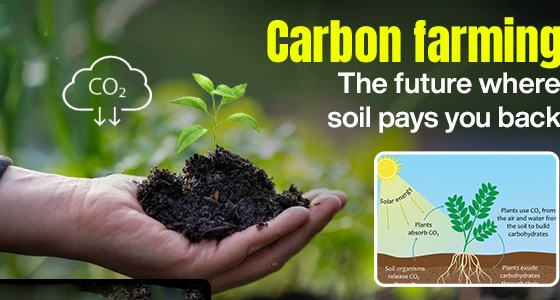
Today, that agricultural waste follows a remarkably different trajectory. Instead of ascending as toxic smoke, cotton stalks are converted into biochar—a carbon-rich, charcoal-like material—and mixed back into the earth. The transformation began when climate-tech venture Equilibrium introduced simple Kon-Tiki kilns to the region, training farmers in controlled pyrolysis to convert waste into long-term soil nutrients.
For Ajay and his peers, adopting new practices required overcoming deep-rooted hesitation. “As farmers, we have always been sceptical about what to use on our land because we are very close to it,” he explains. “Farming is our only source of livelihood.”
Experience, however, is rapidly dismantling that caution. Local farmers report improved crop yields, enhanced soil fertility, and superior moisture retention. Biomass that once choked the atmosphere now rebuilds the earth—highlighting a critical question for the global climate economy: what does high-integrity carbon removal actually look like on the ground?
The Carbon Quality Gap and Building Trust
The global carbon market is on track to reach $50 billion by 2030, driven by more than 4,000 corporate entities committed to science-based net-zero targets. Simultaneously, India is operationalizing its own domestic carbon market, establishing mandatory emission targets across major industrial sectors.
Yet, despite surging demand and capital availability, the carbon market faces a profound credibility deficit. "Demand for climate action was never the bottleneck; trust was," states Siddhanth Jayaram, founder of Equilibrium.
A former venture capitalist who co-founded Climes, Siddhanth realized that boardrooms and financial spreadsheets often disconnected from ground realities. Truly effective carbon removal requires long-term presence, rigorous scientific verification, and direct alignment with local farming economics.
Equilibrium addresses this structural gap by developing and operating high-integrity climate projects directly. To date, the company has engaged over 27,000 smallholder farmers and brought 30,000 hectares under restoration through agroforestry, mangrove rejuvenation, climate-smart agriculture, and biochar production. Its expansion pipeline spans eight major projects across nine Indian states, aiming to cover 120,000 hectares and 150,000 farming households.
Tailoring Solutions to Hyper-Local Ecosystems
As Neelesh Sachdeva, Equilibrium’s Head of Strategy and Origination, emphasizes, carbon interventions cannot follow a rigid, template-driven approach. A project must evaluate land suitability alongside socio-economic viability.
Agroforestry in Tribal Belts: In Madhya Pradesh and Jharkhand, where tribal families hold land that remains partially underutilized due to ownership transfer restrictions, agroforestry offers a path to build multi-generational income without compromising land rights.
Invasive Species Utilization: Across degraded forest borders, invasive Lantana camara shrubs are cleared and processed into biochar, simultaneously restoring native biodiversity and enriching nearby agricultural soils.
Cost-Free Farmer Participation: According to co-founder Sricharann Seshadri, 60 to 70 percent of total project capital is deployed directly into farmer-facing infrastructure—covering saplings, irrigation setups, bio-inputs, and training.
Farmers participate at zero upfront cost. Once high-integrity carbon credits are verified via satellite imagery, geospatial tracking, and field audits, approximately 25 to 30 percent of the credit sale revenue is transferred directly to the farmers' bank accounts. When market prices fluctuate, Equilibrium utilizes blended finance and philanthropic grants to bridge capital gaps, ensuring project quality remains uncompromised.
Returning to Ancestral Wisdom
For Siddhanth, the core mission of soil restoration hit home during a conversation with a veteran Karnataka farmer who had been using biochar for five years. When asked why he trusted the technique, the farmer recalled his grandmother manually working crop residues back into the soil decades ago. To him, modern biochar was simply an engineered continuation of traditional wisdom.
"On a spreadsheet, soil organic carbon is just a number," Siddhanth reflects. "On a farm, that number explains falling yields, drying fields, and why a family is struggling. No financial model prepares you for the fact that the metric you are solving for is a farmer's entire life story."
Ultimately, high-integrity carbon removal measures success not merely in metric tonnes of carbon sequestered, but in living trees, revived soil, and resilient agricultural livelihoods capable of sustaining generations to come.