Bridging the Youth Employment Gap: NITI Aayog’s Roadmap for Skilling India
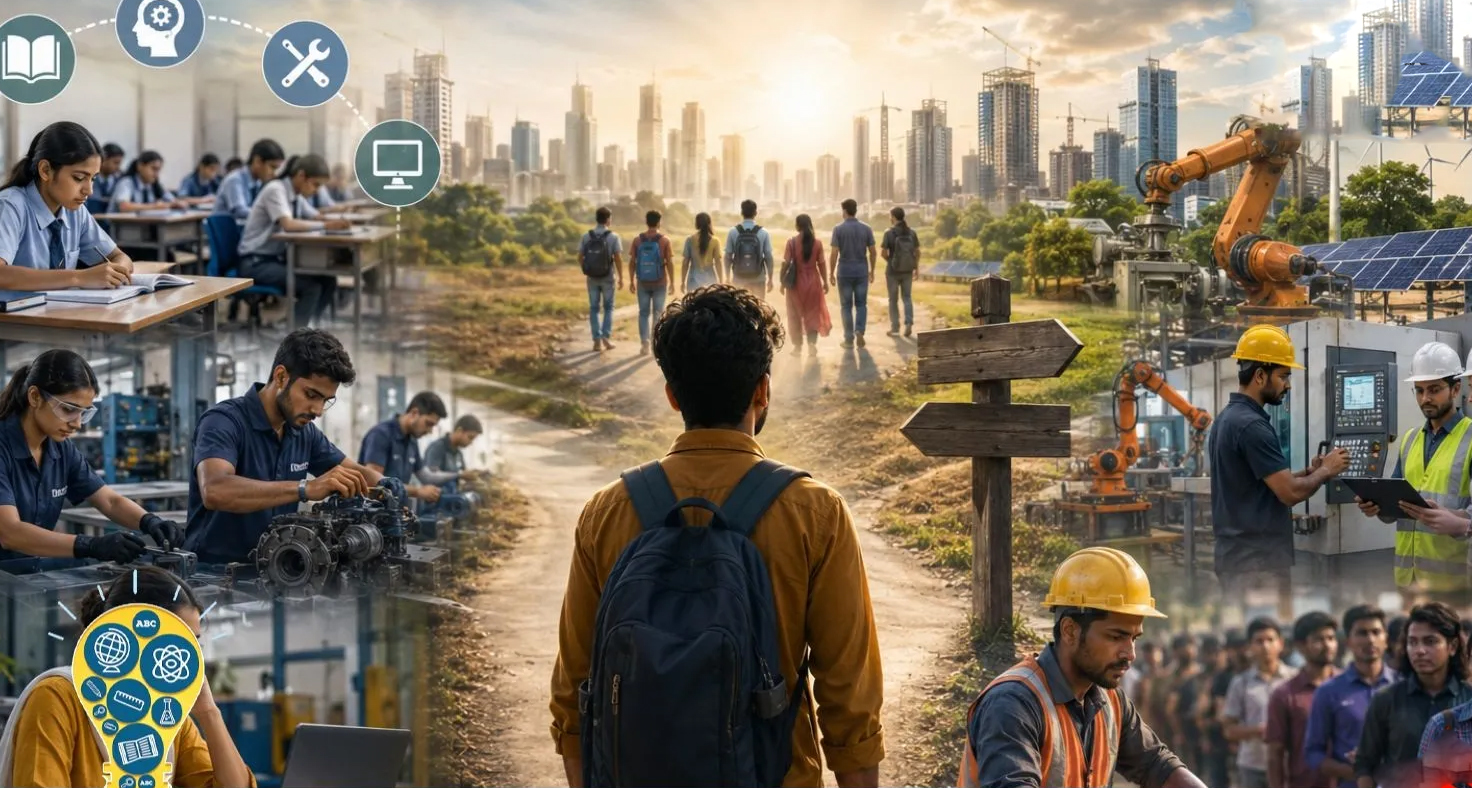
Transforming education into employable expertise is no longer optional—it is the cornerstone of India’s journey toward a $30-trillion economy.
The NEET Crisis and the Employability Gap
India stands at a pivotal demographic juncture, but its vast youth potential faces a structural hurdle. According to NITI Aayog’s landmark report, ‘Reimagining Skilling for Viksit Bharat@2047’, an estimated 8.7 crore Indians aged 15 to 29 were classified as NEET (Not in Education, Employment, or Training) in 2021. Drawing from the 78th round of the National Sample Survey, the report underscores a profound disconnect between academic qualification and real-world job readiness.
A staggering statistic highlights this gap: only 8.25% of graduates are currently employed in roles aligned with their qualifications. For millions of young people—particularly those from low-income households—the high cost of higher education paired with limited practical exposure forces a difficult choice: accept low-paying, mismatched work or risk falling into economic inactivity.
Key Structural Challenges Identified
Weak Education-Industry Linkages: Formal degrees frequently lack industry-aligned specialization, leaving graduates underprepared for market requirements.
Low Vocational Integration in Schools: Despite the provisions of the National Education Policy (NEP) 2020, fewer than 1 in 12 secondary schools currently offer vocational subjects.
Financial and Access Barriers: Additional paid skill training alongside traditional college tuition remains unaffordable for marginalized youth and women.
Fragmented Apprenticeships: While initiatives like NAPS and NATS have expanded access, participation remains uneven across states and enterprise sizes.
Reimagining Skilling: Key Recommendations
To build a resilient and employable workforce, NITI Aayog proposes a comprehensive restructuring of the skilling ecosystem across school, higher, and vocational education.
| Education Level / Focus Area | Proposed Reform Strategy | Expected Outcome |
|---|---|---|
| School Education (Classes 6–12) | Universal General Employability & Entrepreneurship Skills | Early exposure to workplace readiness and foundational business acumen. |
| Secondary Education (Classes 9–12) | Structured 'Kaushal Tracks' & Equal Weightage in Board Exams | Deep vocational specialization aligned with local and national industry demand. |
| Higher Education | Shift from generic degrees to applied, work-integrated programs | Enhanced hands-on experience through modular, earn-while-you-learn degrees. |
| Apprenticeships & MSMEs | Unified digital discovery platform and MSME incentives | Streamlined onboarding and expanded access to credible, paid work opportunities. |
| Emerging Sectors | Targeted training in green industries, EVs, and digital tech | Future-proofing the workforce while reskilling workers from declining trades. |
Beyond Numbers: Outcome-Driven Growth
While India has trained over 7.67 crore people since 2014–15 and allocated ₹34,000 crore toward skilling in the Union Budget 2025–26, NITI Aayog stresses that financial outlay alone is insufficient. Skilling paradigms must pivot from tracking mere participation to measuring verified employment outcomes.
By embedding market-aligned skill pathways directly into school curricula and expanding apprenticeships, India can bridge the gap between education and employment—turning its demographic dividend into an engine of sustainable economic growth.