Reimagining Urban Housing: Turning India’s Shelter Deficit into a Trillion-Dollar Economic Engine
To sustain rapid urbanization and unlock massive economic multipliers across employment and GDP, India must transition from treating low-cost housing as social welfare to positioning it as fundamental economic infrastructure.
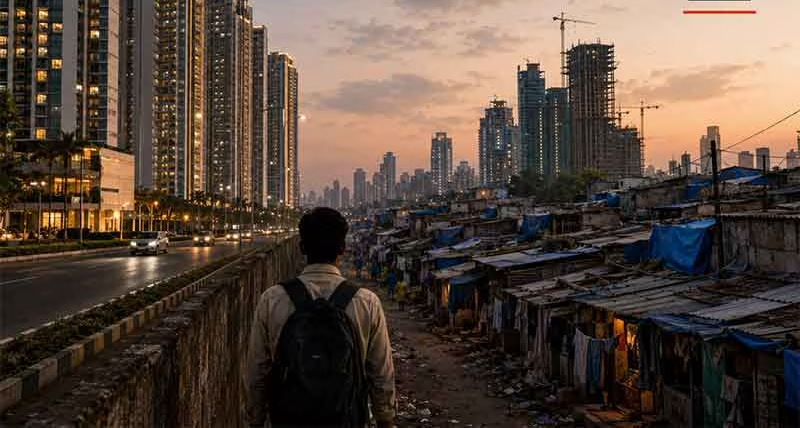
Housing as Productivity Infrastructure Across developing economies, urban centers serve as primary hubs of high productivity, competitive wages, and rapid expansion. While Indian cities strive to absorb rural-to-urban migration, housing policies have struggled to match the scale of this influx. Affordable urban housing is frequently misclassified as charity, redistribution, or pure welfare—a framing that misses its core economic role. Just as roads, power grids, and digital networks underpin economic output, reliable housing forms part of the core infrastructure enabling a productive workforce.
The Scale of the Urban Shortfall
NITI Aayog Estimate (Dec 2025): Projects an urban deficit of 50 to 70 million housing units based on the UN Household Deficit Framework.
CII–Knight Frank Projection: Estimates a conservative deficit of 31.2 million urban homes by 2030.
Government Target: The 'Housing for All' framework targets 10 million urban homes by 2029 under PMAY-U, backed by a 36% budget boost to ₹30,171 crore (FY 2024-25). However, bridging the remaining gap requires deeper structural reform.
Economic Multipliers and Employment Dynamics Housing links directly to core industrial sectors like cement, steel, logistics, and financial services. An ILO study across 45 countries showed that construction sector output multipliers consistently exceed overall national averages, generating roughly $3.60 in economic output for every $1.00 invested in middle-income nations. In India, MOSPI recorded an 8.6% real GVA growth in construction for FY 2024-25.
While the sector employs over 50 million people, informal structures mean roughly 70% of unskilled construction labor earned below prescribed daily minimum wages as of 2022. Formalizing this workforce and raising baseline wages would amplify the induced consumer spending multiplier considerably.
Structural Limitations of Ownership-Centric Models Current schemes heavily prioritize homeownership, which requires land titles, formal creditworthiness, and steady incomes—three hurdles low-income urban residents face:
Beneficiary Construction: Benefits only those who already own land.
Credit Subsidies: Favor households with verifiable formal income streams.
Excluded Demographics: Landless migrants, informal laborers, and daily-wage street dwellers remain unserved.
For urban families earning under ₹15,000 per month in tier-1 cities like Mumbai, Delhi, or Bengaluru, land costs and interest rates make purchasing a home mathematically unviable.
The Strategic Imperative: Public Rental Infrastructure With NITI Aayog projecting India's urban population to expand from 500 million (2021) to 850 million (2050)—adding an influx equivalent to the entire U.S. population—policy must prioritize public-managed rental systems. China previously navigated a similar surge through land reforms, public developer backing, and expanded credit mechanisms.
Proposed Policy Framework:
Build rental housing on public land using private developers via 50-to-60-year leases.
Implement controlled rent structures backed by long-term yields.
Reframing the core question from "How much can we spend on housing the poor?" to "How much GDP growth do we forfeit by failing to invest in urban housing infrastructure?"